Deceleration
Every week we see golfers on TV effortlessly generating clubhead speeds that produce yardages off the tee that we never thought would be possible. Technology advancements have come a long way that are contributing to these numbers, but ultimately this new age of golfers who prioritize sport-specific movements that intentionally translate to the course have advanced the game so much that golf ball manufacturers are now in the process of creating golf balls that travel a shorter distance. What’s the secret here? The majority of these golfers don’t possess a body builder physique to them with muscles popping out of their shirts. The secret is a strong core, an optimized nervous system, and healthy joints that are able to move through a greater range of motion with superior control.
Every Golf Swing Must Come To An End
One of the nonnegotiable elements of any swing is that it must eventually end. Lots of technique focuses on the mechanics of the backswing and downswing transition without addressing how impactful the follow-through can be for power and accuracy. Deceleration is more often the limiting factor in a golfer’s quest for greater club head speed in the follow-through than an actual lack of ability to accelerate or create speed in the downswing. Contrary to belief, just telling yourself to swing harder by cranking back the club deep into your backswing like you’re John Daly and swinging out of your shoes will not actually produce a greater clubhead speed if your body is not primed to take on that stress. Let’s take a look a further look into this concept and highlight the muscles we want to focus on that will give your nervous system more confidence in your body’s ability to rapidly decelerate the club in the follow- through.
The purpose of the follow-through is for deceleration to occur post-impact. Core muscles such as your obliques, quadratus lumborum, psoas major, and transverse and rectus abdominis muscles work overtime during this phase to produce a force that is able to overcome the forces created in the downswing to begin decelerating the club. The lat muscles lengthen during this phase of the golf swing to stabilize the shoulders and safely slow the arms before reaching the end range of the follow-through. Strengthening these muscles can ultimately determine how much control your body has in stopping the swing at a rapid pace. A strong core allows the golfer to decelerate the golf swing almost instantly, allowing for the initial follow-through phase to still allow for the club to accelerate through the shot. A nervous system that senses weak core control will force the body to decelerate the golf swing earlier to prevent injury from occurring.
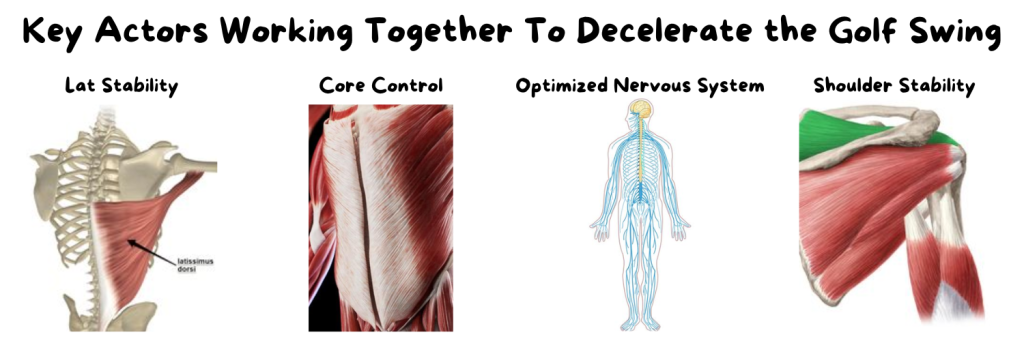
The goal while training deceleration is to produce: 1) a strong core; 2) complimented with building up strength and the range of motion in muscles that help to stabilize the shoulder blade which contribute to rapidly decelerating the arms during the follow-through, primarily the lats and shoulder stabilizing muscles here. Your nervous system understands your golf swing limitations better than any swing coach. Training using this progression is a great way to increase your clubhead speed in a controlled manner.
High End Sports Car vs A Beat Down Car
An analogy taken from “Golf Anatomy,” describes this exact concept as a high-end sportscar that has 200 feet to round a sharp turn near the end of a cliff versus driving a car with no brakes and slick tires rounding the same sharp turn with only 100 feet to spare. The sportscar with new brakes and wheels drives with considerably more speed near the sharp turn because we would trust that car has the ability to stop in time, opposed to the old beat-up car that would have to approach that turn with minimal speed if it wanted to stop in time. The new brakes and wheels are comparable to an optimized nervous system and healthy joints; the increased room to stop the car is equivalent to a body having an increased competence to move through a greater range of motion with superior control. The more space (mobility) your joints have to slow down and the greater ability to decelerate the swing leads to an increased clubhead speed because your body is confident that it can halt the golf swing safely and effectively.
Tree Trouble
A perfect example of seeing this play out on the course is when your ball ends up directly behind a tree creating less room for the follow-through to occur. Players with a strong core and shoulder joints have the ability to generate a fast clubhead speed to deliver a sufficient amount of power into the golf ball while stopping their follow through immediately after impact to avoid hitting the tree with their club. This allows them to advance the ball further without having to settle for punching out the ball to the fairway.
Finishing Thoughts & Takeaways
As a final reminder, because I cannot emphasize this point enough. The nervous system is constantly working to protect the golfer from injury. If the golfer does not possess a body that can support the high velocity of the golf swing that’s being produced, the nervous system kicks into high gear to decelerate the swing sooner rather than later. Increasing mobility throughout the numerous joints in the body coupled with a strong core that is capable of controlling this rapid stoppage of the golf swing will create more room to decelerate near the end of the follow-through. The golfer who has limited mobility and core strength will subconsciously decelerate at impact, losing out on valuable power created during the downswing. I hope you are able to take this advice and apply it to your own game, creating a resilient body that is able to produce your best rounds of golf in the near future!
-Justin Moffatt, HGP
References:
Davies, Craig, and Vince DiSaia. “Golf Anatomy.” Human Kinetics, 2019.
*****The information provided by Harvest Golf Project is for general informational purposes only. All information on the Site is provided in good faith and not intended to be a substitute for professional medical advice, diagnosis, or treatment*****