The Benefits of Utilizing the GolfForever Swing Trainer
I purchased a GolfForever swing trainer just over a year ago and I will be the first to tell you, I completely underestimated the benefits it has for building a resilient body to take on the dynamic nature of the golf swing. It has been a fresh, new approach of introducing non-traditional movements that target specific muscle groups that are simultaneously recruited during the golf swing. Exercises utilizing the swing trainer seem to appear not nearly as intense or effective compared to heavy Olympic weightlifting movements, but I quickly learned that this tool has the capabilities to serve a purpose that goes beyond strength training alone. The swing trainer teaches different parts of the body how to efficiently work together to achieve a common goal, in this case, performing an athletic movement that demands balance, mobility, stability, core strength, and coordination. This is some of the magic that comes with utilizing the swing trainer.
We Live in An Asymmetrical World
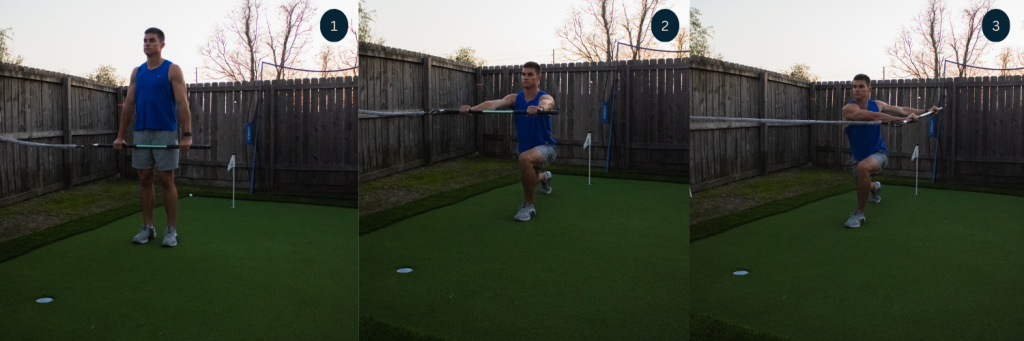
Whether you are hitting a golf shot or walking through the grocery store, you are performing an asymmetrical movement. When you are simply walking, one foot moves in front of the other while one arm swings forward as the other swings backwards. If you think of the body in motion during the backswing, the target side oblique lengthens while the opposite oblique on the trail-side contracts to create rotation through the upper body. The target side shoulder muscles and lat lengthen while the trail-side posterior rotator cuff muscles retract the shoulder blade toward the midline of the body to achieve the full position of the backswing. Many of the lifts targeted in a gym setting primarily focus on bilateral movements where both extremities are able to evenly distribute the load symmetrically across the body. On the other hand, because the swing trainer is attached to a fixed anchor point that will be positioned closer to one side of the body than the other, these movements tend to exhibit challenges towards the body in an asymmetrical fashion. That’s the beauty I have found in using the swing trainer. With that being said, asymmetrical and symmetrical loading each come with their own set of benefits and drawbacks, so it is important to know the differences between the two and how to effectively incorporate both movement patterns into your own golf-specific training.
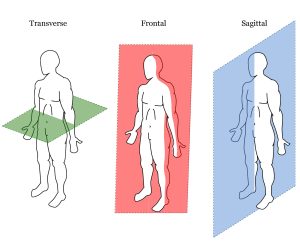
Symmetrical Loading: An exercise where both extremities are performing the same movement pattern with an evenly distributed weight in the frontal and sagittal planes of movement.
Benefits: This is the best way to develop absolute strength. Since more muscles are recruited during the movement and balance tends to not be a limitation, you can create more intensity and lift heavier resistance.
Drawbacks: The body gets configured into unnatural movement patterns that don’t translate to athletic movements as effectively. Balance and stability are relied upon less to achieve these movements.
Asymmetrical Loading: Loading that is not symmetrical in the frontal or sagittal plane.
Benefits: Targets stability, balance, and coordination while evening out muscle imbalances throughout the body, focusing on more selective muscle activation to maintain body form.
Drawbacks: Since these movements challenge balance, stability, and coordination the most, this reduces the potential for loading and using heavier resistance.
Without Stabilization, There Is No Mobilization
Symmetrical loading patterns are seen during traditional lifts such as the back squat or bench press, which target the large mobilizing muscles in the body that are meant to move joints and limbs in a powerful fashion. The GolfForever swing trainer will primarily target stability, coordination, and balance through multi-planar movements to activate the smaller, not so noticeable stabilizing muscles during the movement. Without training your stabilizing muscles, the large mobilizing muscles won’t be put to use nearly as effectively during the golf swing.
Leverage the Swing Trainer To Correct Swing Faults
One of the major benefits of the GolfForever swing trainer is the challenges it demands to stabilize the body while fighting against the resistance to maintain an athletic posture throughout the movement. The human body functions in a 360-degree world and requires a balance of integrated muscles working together to stabilize the skeleton at various angles and ranges. Similarly to the golf swing, the body must be able to work together in order to counteract the forces that are trying to take the player out of a proper golfing posture during the dynamic movement of the golf swing. For example, this can come in the form of early extension during the downswing, as the core musculature must be fully engaged to control pelvic tilt at impact to prevent the hips from thrusting towards the golf ball. Intentional training that focuses on recruiting muscle from the core to the extremities while additionally supporting the spine will go a long way for a player that struggles with losing posture during the swing. This is the perfect problem to bring to the swing trainer as it will help you address and alleviate the undesired swing characteristics that rob you from power and accuracy.
Balance Training
Additionally, the swing trainer targets your balance system and challenges it to a very high degree. When I begin to learn a particular swing trainer movement, I typically start with a wider base. As I become more comfortable with the movement and grasp the technique, I “earn the intensity” to narrow my base or perform the movement on one leg to challenge my balance system even further. The golf swing is all about staying within the working limits of your balance system, responsible for keeping you under control throughout the duration of the golf swing. The harder a golfer swings without being able to control the body on all levels, the looser and out of control their game tends to be. Building up your balance system earns you the intensity to swing harder while keeping those forces under control.
Taking Advantage of the Stretch-Shortening Cycle
The Swing Trainer also has capabilities to increase strength and mobility. A sufficient range of motion can completely enhance the golf swing. Due to the nature of the swing trainer’s asymmetrical loading patterns, one side of the body will recruit muscles that eccentrically lengthen under load while the other side may involve muscles that contract to counteract the forces acting on the body. This promotes the principle of stretch-shortening muscle patterns that golfers use to their advantage to produce a powerful force at impact. During the backswing, the target-side lat and oblique lengthen as the upper body coils into the full position of the backswing. As the player transitions into the downswing, those same muscles forcefully contract to generate clubhead speed and power. This is an example of the stretch-shortening cycle, as a significant contribution of force comes from the rapid recruitment of muscle fibers elicited by the stretch reflex.
Final Thoughts
The swing trainer has also unlocked a creative, experimental part to golf-specific training. GolfForever already offers hundreds of unique movements to help the golfer but so many more movements have yet to be discovered. Its universality is unparalleled to most other traditional training movements. A younger player may be able to squat heavy weight for reps opposed to the senior player who possesses less strength, but I’ve seen many seniors who are able to perform swing trainer movements way more efficiently than the strong, young player as a testament to their enhanced stability, coordination, and balance. The swing trainer will attack your weaknesses, yet through consistency you can turn your weaknesses into strengths. This is why for all body types, ages, and skill levels, I incorporate the GolfForever swing trainer into my method of instruction. Whether I use this as a tool to strengthen core, balance, stability, or mobility, it serves a great purpose for each individual unique to their physical body limitations.
-Justin Moffatt, HGP
Sources:
Hansen, Derek, and Steve Kennelly. Plyometric Anatomy. Human Kinetics, 2017.
“Using Asymmetrical Exercise to Correct Bilateral Training Problems.” NCSF.org, www.ncsf.org/blog/25-usingasymmetricalexercisetocorrectbilateraltrainingproblems. Accessed 12 Mar. 2024.
*****The information provided by Harvest Golf Project is for general informational purposes only. All information on the Site is provided in good faith and not intended to be a substitute for professional medical advice, diagnosis, or treatment*****