Early Extension
While performing a physical screener on a player and evaluating their swing, I have developed a heightened awareness in seeking out any physical body limitations that lead to possibly the most detrimental swing characteristic of them all, early hip extension during the downswing. The purpose of this article is to share my personal insight and own experience on early extension, how it negatively affects the golf swing, and what muscle groups we must address to correct this swing fault. If a player has early extension coupled with other undesired swing characteristics, I typically start out addressing early extension because once these muscles become stronger and enabled to move through a greater range of motion, I tend to see other swing faults associated with early extension correct on their own.
Identifying Early Extension in Your Swing
Early extension is seen when a player transitions into their downswing while prematurely losing their hip hinge and spinal angle, resulting in an early hip extension that thrusts the hips towards the golf ball before impact. Below are split images of Justin Thomas and Wyndham Clark demonstrating superb pelvic stability and lower body separation, keeping their hips on the line from their address position throughout impact.
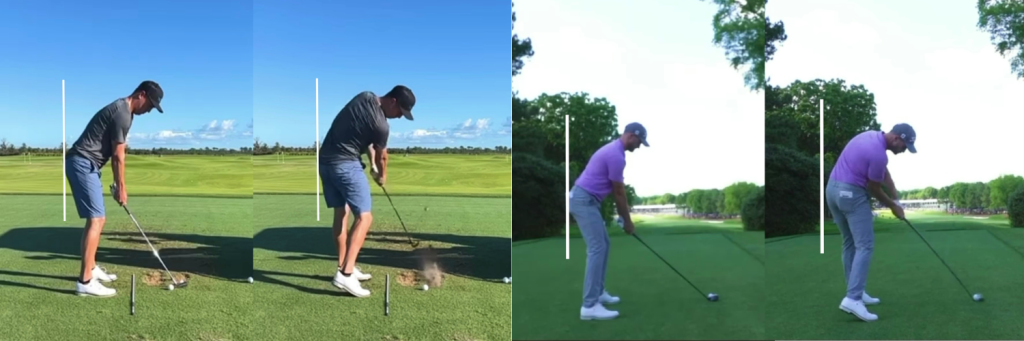
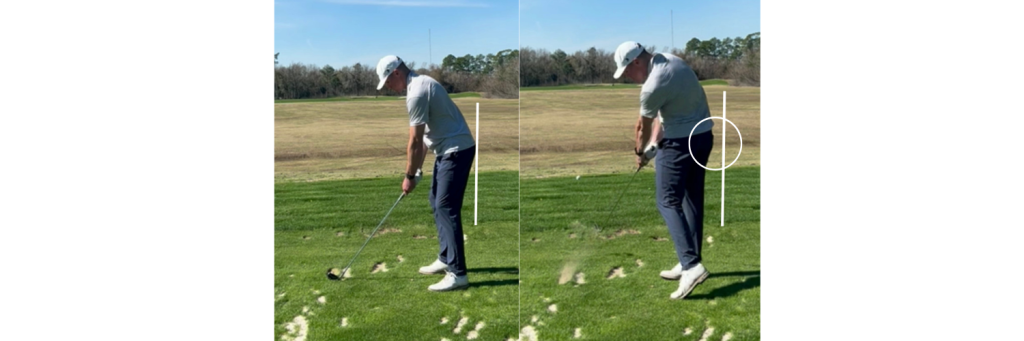
These players are able to generate as much power as possible while creating room for their arms and club to travel inside-to-out, leading to a consistent swing plane shot after shot. Below these two golfers is a split image of myself at address and at impact. You will notice something different here. At impact, there is light between the vertical line and my hips, a sign that early extension occurred during my downswing. I quickly came to realize that no matter how many swing drills I watched online, my hips still wanted to naturally thrust and prematurely extend towards the golf ball before I reached impact. This is when I discovered that this is one of those swing characteristics that isn’t occurring because of a technique issue, it’s occurring due to a physical body limitation. Unless the muscular limitations are specifically targeted through training, there will be little to no progress in overcoming this swing fault.
Hip Extension: The Most Powerful Movement In All of Sports
Say you have to toss a medicine ball as high as you possibly can vertically in the air. Are you going to keep your hips mute and have your arms do all the work for you? Of course not. I bet you would naturally squat as deep as possible before forcefully pushing your heels into the ground and fully extending at your hips and knees just before launching the medicine ball through the air to generate the most amount of force. This same concept applies to the golf swing and early hip extension. Hip extension during the downswing signals that the player has just performed the most powerful movement in all of sports… a little too early. In doing this, the player is sacrificing distance and power simply because they aren’t fully utilizing the working muscle’s abilities to apply a force to their greatest potential, which is where it’s appropriate to mention the principle of the stretch-shortening cycle. During the stretch-shortening cycle, a muscle is first actively stretched before it actively shortens. The force, work, and power output during the shortening phase is enhanced compared with muscle shortening that is not preceded by an initial active stretch. To simplify this, think of a muscle as if it were a rubber band. The further it is stretched from its original length, tension and resistance build up in the band. Once the band is released, a great force will shorten it back to its original length. A skilled player uses this to their advantage by maintaining that stretch potential to allow for the working muscles responsible for hip and knee extension to actively shorten to maximize power during the golf swing.
Getting Your Hips Out of the Way
Another issue that comes with thrusting the hips towards the golf ball on the downswing is the player creates less room for their hands and club path to travel on that desired in-to-out swing plane. I alluded to this at the beginning, but when a player extends at the hips early, it is almost always accompanied with another swing fault, such as the over-the-top swing path. Since the hips have created less room between the player and the golf ball, the only option for the hands and club to travel is from outside-to-in, leading to a slice or pulled shot depending on the position of the club face at impact. If a player extends the hips early and attempts to swing in-to-out, their hands will get jammed on their body. That is why when early hip extension is addressed it tends to alleviate other present swing faults.
A Strong Core Leads to Strong Pelvic Control
A very minute movement occurs at impact that is difficult to see with the naked eye, but this is what tends to separate elite ball strikers from the rest of the field. At address and throughout the golf swing up until the player is a fraction of a second away from making contact with the golf ball, the pelvis should remain in a neutral to slightly forward tilted position. Upon impact, the pelvis will rapidly tuck underneath the player towards the tailbone, drawing the abdomen inwards to create a crunch-like position. This is the most efficient way to transfer power from the lower body to the upper body without allowing any power to leak. This skill allows for the golfer to maintain a proper hip hinge and spine angle to support their golf swing while the hips rotate through impact, eliminating early hip extension from the golf swing altogether.
Muscles and Movement Patterns That Will Combat Early Hip Extension
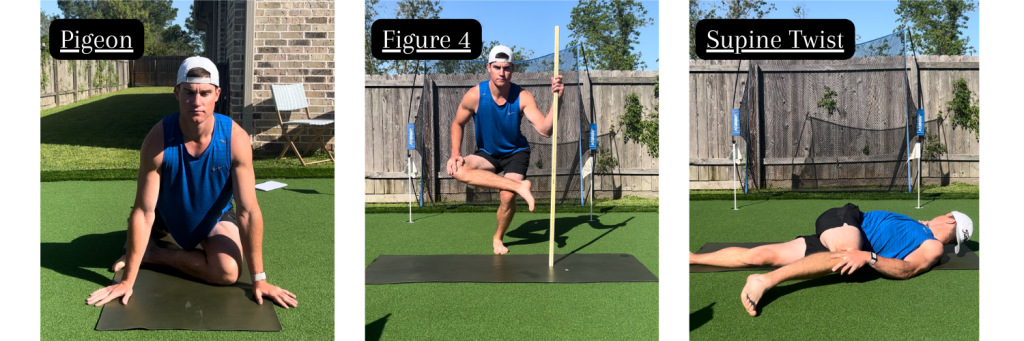
Internal rotation of the lead hip allows for the lower body to fully rotate without thrusting towards the golf ball. If the pelvis is unable to rotate around the lead hip, forward and lateral movements are going to dominate the golf swing. The muscle group we want to target here are the hip external rotator muscles located underneath the glute muscles. In order to unlock hip internal rotation, these muscles must be able to properly lengthen and stretch to facilitate this movement. The glute muscles will also lengthen while internally rotating around the hip. The pigeon pose, figure four stretch, and the supine twist are all great ways to stretch out this muscle group, allowing the pelvis to rotate around the hips more freely during the golf swing.
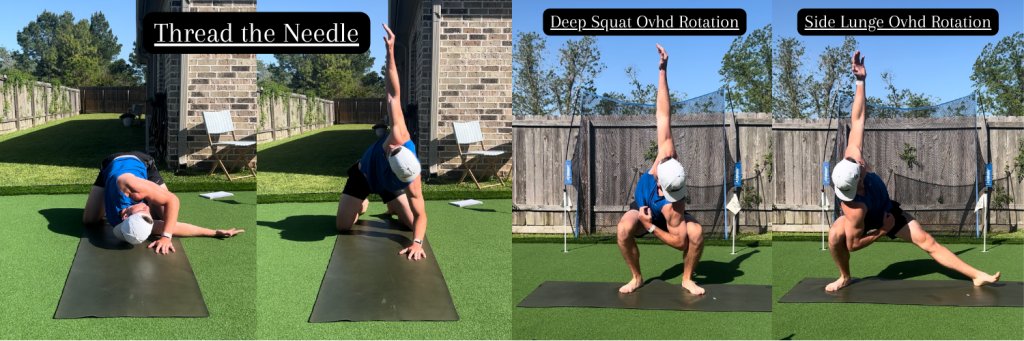
Eliminating early extension also means the player must be able to separate their lower body from their upper body. An efficient golfer will initiate the downswing by generating speed from the lower body before the upper body. This places the lower body in an advantageous athletic position to allow for an efficient transfer of power from the ground-up. Hip mobility, spinal rotation, and lengthening of the latissimus dorsi are all key factors in play to allow for this proper sequencing to occur. Threading the needle, deep squat rotations, and side lunge rotations effectively target these key muscle groups to produce a better firing sequence during the down swing.
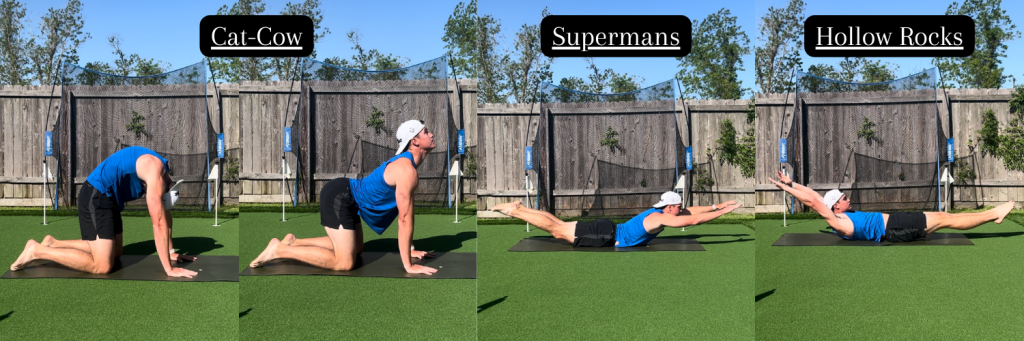
Lastly, the core is king in preventing early hip extension from occurring during the downswing. The body’s ability to control the position of the pelvis will help prevent the hips from thrusting towards the golf ball. When you think of the core, don’t just think of a six pack. Core muscles are all the muscles that stabilize, protect, and move the spine. These muscles include the abdomen, diaphragm, spinal extensors and rotators, obliques, lats, glutes, and hip flexors. The cat-cow yoga sequence mimics the movement of the pelvis at impact in an exaggerated manner, hollow rocks strengthen the abdomen while also lengthening the lats, and Superman’s serve to strengthen the spinal erectors.
Get Screened Today
The purpose of the Screen and Swing package offered at HGP goes beyond a simple quick-fix instructional video that is unable to account for the players own physical body limitations. Telling the player to maintain spine angle while rotating the lead hip away is easier said than done, and if the body isn’t prepared or capable of performing a complex movement like this, injury and frustration can ensue. Early hip extension is just one of the 15 swing characteristics that are assessed to better pinpoint which parts of your body have the greatest room for improvement. Get screened today by hitting the “Get Screened” link at the top of the HGP website. I hope this article provided you with valuable insight that you can take with you to the gym and the course to help limit early hip extension from occurring during your downswing. I will leave you with one quote from a book that inspired me to begin this journey of helping other golfers alike maximize their potential in the gym, on the yoga mat, and on the course!
“If your body is unable to move the way the golf swing requires, it won’t matter how new your clubs are or how many swing training aids you have used. You will not be able to make the consistent powerful swing you desire.”
-Justin Moffatt, HGP
References:
Seiberl W., Hahn D., Power G.A., Fletcher J.R., Siebert T. Editorial: The Stretch-Shortening Cycle of Active Muscle and Muscle-Tendon Complex: What, Why and How It Increases Muscle Performance? Front. Physiol. May 20, 2021.
Davies, Craig, and Vince DiSaia. Golf Anatomy. Human Kinetics, 2019.
*****The information provided by Harvest Golf Project is for general informational purposes only. All information on the Site is provided in good faith and not intended to be a substitute for professional medical advice, diagnosis, or treatment*****